

I was confused the first time I heard a girl complain about being “objectified”. How does me being horny make you an object? I don’t want to have sex with objects. I don’t even want to have sex with objectivists! I just wanted to have sex with you, and now you’re mad.
Objectification as violation makes sense in the frame described in the last post. Skilled feminine performance consists of demonstrating control over how sexy / threatening / inconspicuous you are perceived to be. It’s not about being maximally sexy or unsexy all the time. Objectification is denying a woman that control by perceiving her as sexy when she wishes not to be seen that way. It’s not objectifying to sexualize a stripper on the pole; it is objectifying to sexualize a nurse in scrubs. It’s a violation of her will — her subjectivity.
Being subjectified/objectified is itself a balancing act that we perform. We don’t always want maximum subjecthood, that is — demanding maximal deference to our subjective point of view. This is cognitively demanding of other people. It makes you more threatening and dominant, less trustworthy and likeable. A big part of charisma is setting aside your subjecthood: demanding little of other people, “yes, and”-ing their frame instead of insisting on yours, flowing like water.
We self-objectify by playing out roles with strictly defined scripts: student in class, barbecue host, regular at the bar, any job that involves a uniform. No one thinks too much about the postal worker’s unique interiority or point-of-view — while in-uniform they are a mail-delivering object.
The same works for sexual objectification. You can sexually self-objectify by communicating your commitment to playing out a predictable sexual script.

This ↑ guy is going home with someone from the bar at 2 am not because his palm-reading trick is irresistible to women. The girl who’s there alone at 2 am wants someone to fuck her tonight, as long as she’s sure he won’t catch feelings and text her the next day. The peacocking performance demonstrates a man’s commitment to doing just that. This pick-up artist is an object and, indeed, a tool. He’s there to be used.
The important question: is this by choice? Could he drop the act if he wanted to, and subjectify? Presumably: yes, if he’s not completely PUA-brained. He could show up to the same bar the next day with a dark hoodie and a menacing glare and have every woman worrying what’s on his mind and not what’s in his pants.
Made Up Subjects
Who do women wear makeup for?
You sense a trick question. Fine, I’ll let you google the answer:

No trick here. If you’re reading the English-language internet in the century of our Lord the 21st, you know that women only ever wear makeup for themselves. And in fact, every single woman in a 21st-century makeup ad is entirely by herself. Not a single ad shows the woman, after having spent an hour applying the featured makeup, being looked at. She is the one looking, whether at the fourth wall or at something of interest off-screen. She is the subject, the one with a point-of-view.
Now, something funny has happened. When modern makeup was popularized during the post-WWII baby boom, the answer to “who do women wear makeup for?” was also clear to absolutely everyone. Except — it was the opposite answer.

In 1950, everyone knew that women wear makeup for men to look at. In 2025, everyone knows that women wear makeup for themselves. Did something happen to men that they stopped looking at made-up women? Did something happen to women?
“Women were liberated from the patriarchy.” Let’s grant this for the sake of argument. Lipstick was invented by patriarchs to paint their women a more pleasing shade, as one would any household object.
But then, why are women still painting themselves? The global beauty industry went from $6B in today’s dollars in the 1940s to $600B today. Why are women painting themselves 100 times as much “for themselves” as they did when the patriarchy forced them?
Astute readers may sense a TLP quote incoming, and they’d be correct:
When they say, "it's a woman's choice" what they mean is "it's not a man's choice, it is thoroughly stupid to wear make up just for men, the only acceptable reason is if you do it for yourself, if it makes you feel better about yourself."
Let me offer a contrary position, unpalatable but worth considering: the only appropriate time to wear make up is to look attractive to men. Or women, depending on which genitals you want to lick, hopefully it's both.
I'm not saying you have to look good for men, I'm saying that if wearing makeup not for men makes you feel better about yourself, you don't have a strong self, and no, yelling won't change this. Everyone knows you shouldn't judge a book by its cover, now you're saying the cover of the book influences how the book feels about itself?
I am not doubting that in fact you do feel better about yourself, I am saying that that fact is both pathological and totally on purpose.
An even weirder phenomenon that TLP also notices: the same psy-op is played on men using the exact same language.
Self-objectification for women comes in pinks and reds; for men — in glass and chrome. Sports cars, luxury watches, designer glasses, cologne, premium liquor. These used to be marketed to men with an explicit message of it will make girls want to fuck you. Today, if a rare ad features a blonde looking lustfully at the consumer it’s a startup brand looking to capitalize on controversy by breaking norms on purpose.
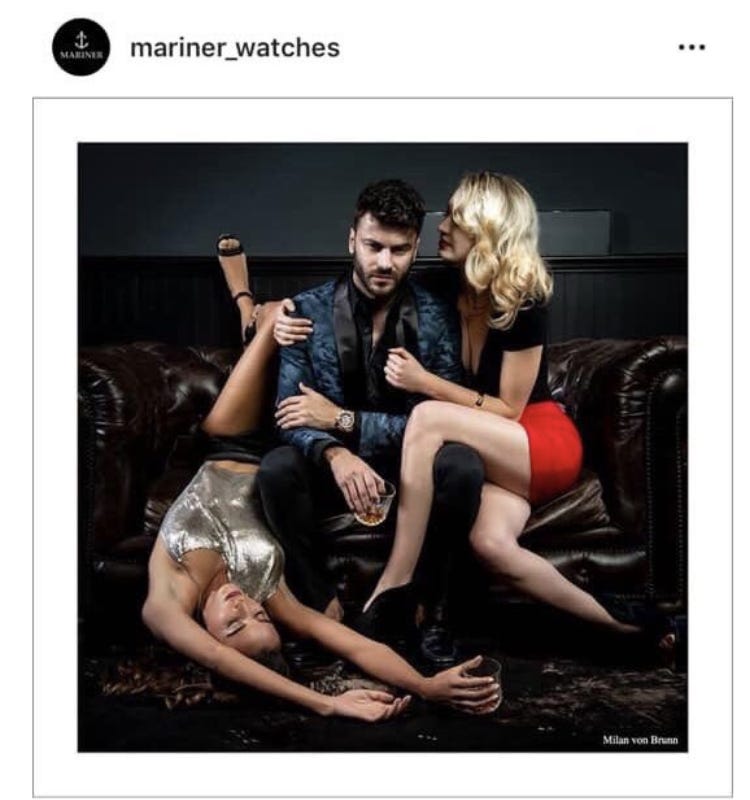
The controversy, of course, is that advertising a man’s watch for the female gaze is sexist, which is… the same exact sin of advertising women’s makeup for the male gaze.
Self-objectifying is doing a sexism and a patriarchy. And since liberal society has liberated us from patriarchy and sexism, self-objectification is no longer allowed (unless you’re queer, in which case it’s mandatory.) If you can no longer objectify yourself, who will objectify you?
Liberal society, of course.
All the King’s Objects
subject /ˈsəbjək(t)/ n.
a citizen or member of a state other than its supreme ruler
The king calls his serfs subjects because he would rather they be objects. The kingdom would run so very smoothly if everyone acted out their role with proper attire and behavioral scripts. No ruler wants to deal with subjects, with individual wills and points of view.
Liberal democracy has no subjects because even its ruling class is objectified. Politicians, bureaucrats, and “experts” derive their power primarily from being affiliated with institutions and following institutional codes. When subjectivity arises in the form of a maverick politician, disruptive entrepreneur, or some identitarian movement, these are generally seen as standing in the way of progress and liberty.
TLP asks:
Do you want power, or the trappings of power? Somebody's going to have it, you can't make it vanish.
He’s talking about serious power, but let’s start small. Do you have the power to wear makeup just for men, or just for women, or not wear it at all? A lot of women feel like they don’t, or at least that they can’t freely admit to it. Even when someone like Kryptogal suspects that makeup satisfies an external demand and isn’t “for herself”, she still feels coerced.
Women didn’t have any more freedom in the 1950s or the 1050s. No society lets people choose how sexy they’re going to be each day without a fight. Liberalism does at least grant you the freedom of choosing from more than one script. If a woman in 2025 really can’t stand painting her face or plucking her hairs, she can become a wild hippie, a radical feminist, or Amish. Each of these define exactly which men will sexualize her and to what extent. But at least she can choose.
The problem is that society lies about how much freedom you’re truly granted. A woman gets upset that a man on the street perceives her tits underneath a $1000 business blazer. But what freedom is that depriving her of? In a patriarchal society like, say, the Mongol Khanate, he could tie her up on his horse and gallop away. Now that would be an object lesson.
In 2025, she’s free to completely ignore him. What she doesn’t feel free to do, if she’s at the salary range where single wardrobe items run to four figures, is to wear something actually man-repellant to the office.
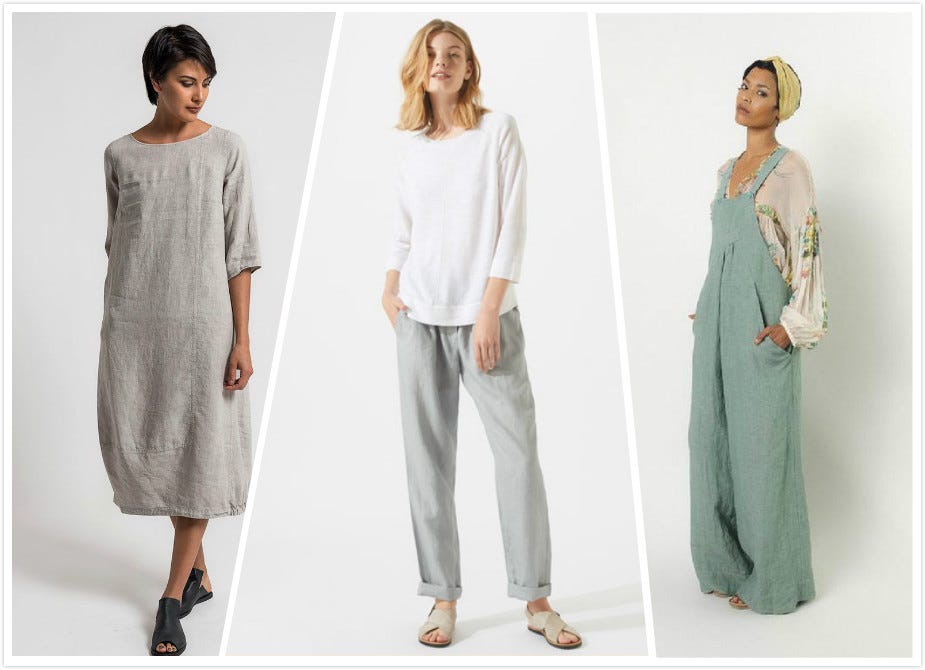
Society forces women towards a culturally-specified balance point of sexiness, and it also forces men to play along. If a man implies that you’re sexier than the approved set point that’s objectification and it’s bad, but if he says “oh, I don’t even see you as a woman in this outfit” that’s much worse. It’s a decent way for everyone to go about their day experiencing acceptable levels of sexual repression. Better than Mongols, for sure.
But we said that femininity is about demonstrating power over your sexuality, and submitting to cultural nudges gives you very limited power. So female power must come from breaking the script.
Femaleness
Camille Paglia on Elizabeth Taylor:
At the very moment that I was rebelling against the coercive role of femininity and modeling myself on my other heroine, the intrepid, masculine Amelia Earhart, I also recognized that Taylor’s mystery and glamour were coming from nature, not culture.
Elizabeth Taylor is pre-feminist woman. This is the source of her continuing greatness and relevance. She wields the sexual power that feminism cannot explain and has tried to destroy. Through stars like Taylor, we sense the world-disordering impact of legendary women like Delilah, Salome, and Helen of Troy. Feminism has tried to dismiss the femme fatale as a misogynist label, a hoary cliche. But the femme fatale expresses woman’s ancient and eternal control of the sexual realm. The specter of the femme fatale stalks all of men’s relations with women.

Are Liz Taylor’s legs waxed? Are her nails manicured? They probably are, since she’s being paid to model here. But as a woman, these would be entirely optional for her. If you can channel enough raw force to look at a man like that, you don’t need an elaborate performance to demonstrate your power over sexuality. If you have tits like these and still no one can look away from your eyes, you’re definitely not an object.
The last essay was a dialectic on the question of what performative femininity is showing and to whom. Thesis: it shows sex appeal to men. Antithesis: it shows norm-adherence to women. Synthesis: it appeals to men by showing mastery of one’s sex appeal to women.
A differtent question: what is performative femininity hiding?
It’s hiding femaleness.
To channel Paglia again: femaleness is the biological nature of women. It’s blood and birth and death, amorphous contours and capricious moods. It is a source of terror and of sexual desire.
Raw maleness still contains within it the masculine drive for systematized order. But raw femaleness makes a mockery of it. Civilization is a desperate defense against the messy churn of nature, and the female body is how nature gets in. It follows its own calendar cycle. Consequently, civilization always seeks to constrain and sanitize femaleness. Patriarchal societies hide femaleness behind veils and in “menstruation huts”. Liberal societies try to pinkwash femaleness with a thick coat of femininity.
A funny example is the domestication of the adjective “fierce”, which has seen a recent 10x increase in its application to “woman”. A fierce woman contributes to the humanities literature, wears pantsuits in middle age, reflects the heart of Jesus Christ, promotes female solidarity. If these don’t evoke for you a female cheetah with fangs bared protecting her cubs from a lion you must be suffering from masculinity. We’ll have to run a toxicology test.
I got a lot of responses to my authentic wanting exercise from guys who are quite successful in most areas of life but who have very little experience dating. They describe wanting women who can hold a conversation on their favorite nerdy topic, who like reading and cooking and travel, who are serious about marriage, who are competent and ambitious and emotionally mature. These are indeed good things to look for in a partner. But I’m tempted to ask: do any of these require that she be female?
The whole chapter on femininity was inspired in part by this Eigenrobot thread on male sexual maturation. From the thread:
sexual maturation in a heterosexual man requires among other things an internal alignment such that he is not mentally fucked up about femaleness
femininity for women is, aside from an avenue for self-realization, a tool by which they may cultivate social power or strength the use of femininity to obtain sexual influence over men demands a form appropriate for the sexual interest of a given audience
in the case of a sexually callow heterosexual male audience, of men who are terrified of pussy, an optimal femininity takes the form of the maximal suppression of femaleness, and of totalizing artificiality
Femininity is a demonstration of sexual power, but only of a very limited sort. It is the sort of power that isn’t threatening to women, children, polite society, and men who aren’t yet entirely sure who they are and what they want. Femininity demonstrates control, but itself is controlled by social norms and expectations. A woman is allowed to paint her face in attention-grabbing colors, but not to revel in her ability to grab a man’s attention against his will. Because patriarchy, or something.
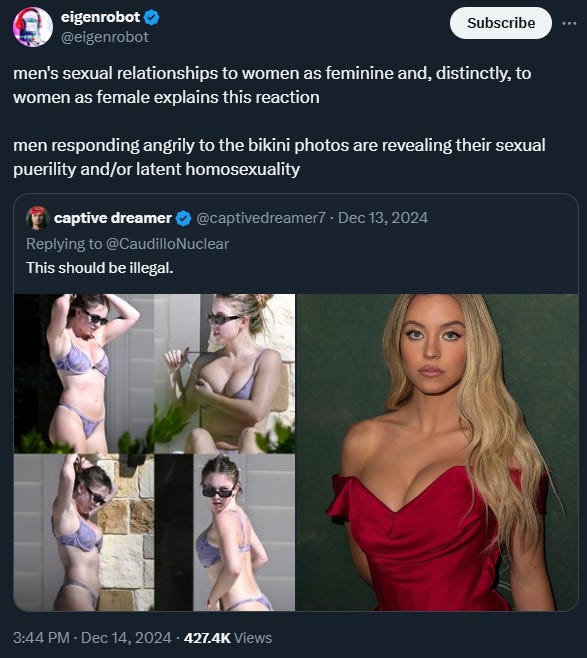
There’s another sort of sexual power that isn’t controlled, that’s wild and lawless and can’t be rehearsed. It’s Sydney Sweeney’s power to get a million men on Twitter (X-men?) worked up with just four no-makeup photos. Note: no matter how much these bikini photos turn you on, it doesn’t feel “objectifying”. She’s not trying to be sexy or not be sexy; she doesn’t even know you’re there. There’s no performance you can contradict, and what is there is incontrovertible.
This power is scary. Imagine: you have to ask Sydney Sweeney out on a date or we shoot your puppy. Is it more terrifying to approach when she’s looking like the candid photos or when she’s styled and painted in an evening gown? Exactly.
Female power attracts male power and vice versa. Another theme in the authentic wanting responses: almost every guy has written that he’s looking to get married soon. When I follow up, many of them admit that actually they’re looking to “build confidence” and “develop an abundance mindset” first. What they mean in practice is that they want to get enough pussy that they’re no longer insecure about getting pussy — that’s male power. I think this shows strong self-awareness, and I’m optimistic about these guys getting married in the next few years.
I did the exercise once with a friend who has rich sexual experience with men, women, and everyone in between. He started with a list of 10 things he’s looking for in a wife, then crossed off most of them for being too vague, too common, too mimetic, or too trivial. When I asked what was left he said: “she needs to be dangerous. creepy. slightly evil" and he gave a knowing smile.
The tweets saying "this should be illegal" are IMO making the opposite claim to how you read them. IE: the made-up evening dress look should be illegal, not the bikini pics on the left. The bikini pics are of a normal attractive woman. She is human, approachable, anyone could be her friend. The pic in the dress is literally not real. That person exists only on film, and only after many hours of expensive specialized labor. "The men" (or whoever) are being fed a superstimulus that cannot exist, and in the process their model of what a normal human they can interact with actually looks like is destroyed.
I think the claim is akin to "advertising heroin should be illegal." Or maybe "fraud should be illegal." Made worse by the fact that one is supposedly victimized by the heroin/fraud simply by seeing the photo which is usually involuntary -- an infohazard was thrust in front of them and has degraded their ability to have real relationships with real women.
"Raw maleness still contains within it the masculine drive for systematized order. But raw femaleness makes a mockery of it."
As a female, I'm always mystified about such claims. Is it anything real or just an urban myth that men are about logic and women are somehow not? I always liked the nice, well-systematized stuff - all kinds of stuff, including feminine, nicely systematized. Look at Aella - she's trying to draw logical models of human behavior and that's why we read her, right? Can it be that women have other and sometimes more complex goals in social matters and that's why men find women's actions and feelings illogical, not knowing what the goals are?